Vocal fold (vocal cord) paralysis means that one or both vocal folds no longer move normally because the nerve supplying them is damaged. Common causes are surgery of the thyroid, chest or neck, tumours along the nerve’s course, and viral infections; in some patients no cause is found.
Symptoms
With one-sided paralysis the voice becomes weak, breathy and tires quickly. Coughing can be weak, and liquids may go down the wrong way. How much the voice changes depends on the position in which the vocal fold is paralysed, and on how much stiffness and muscle mass it has lost.
Some paralyses recover over time, but it is almost impossible to predict how well and how quickly. Recovery is usually followed for several months before permanent treatment is chosen.
Treatment options
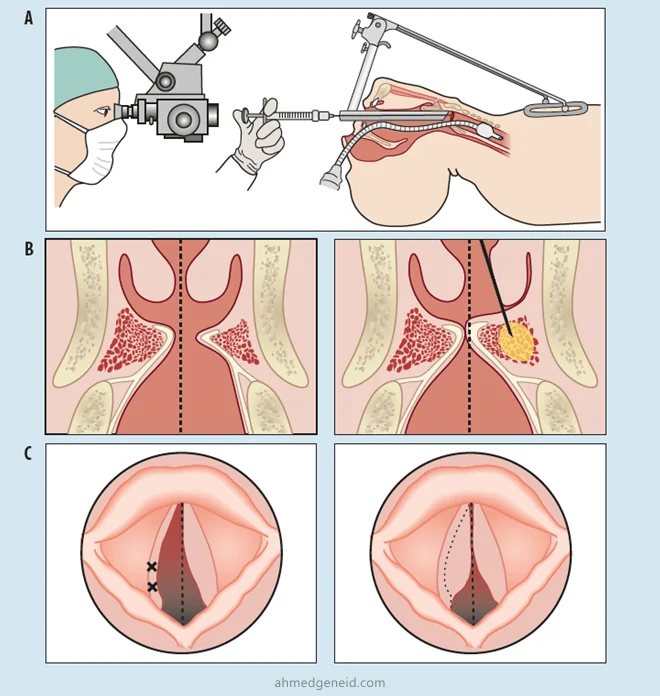
The choice depends on your voice needs. One-sided paralysis is treated by augmenting the vocal fold (adding volume) or by correcting its position. Some procedures are done under local anaesthesia, others under general anaesthesia.
Temporary augmentation for recent paralysis improves the voice straight away. The filler dissolves if the paralysis recovers on its own.
Fascia augmentation: we have long experience of using fascia as vocal fold filler. It is the only permanent filler taken from your own body.
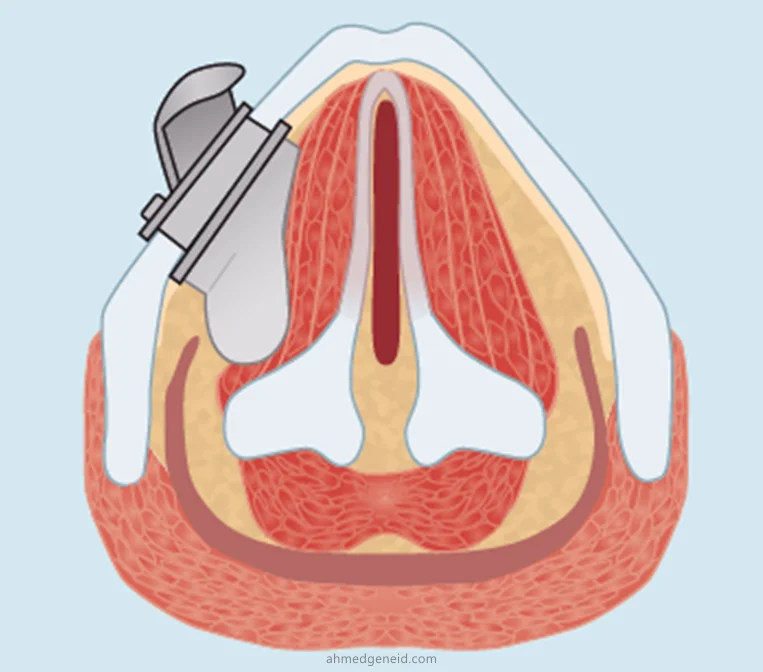
Implant (medialisation) thyroplasty moves the vocal fold permanently towards the midline. See Implant thyroplasty.
Voice therapy is often combined with these treatments.
Illustration: Geneid & Kinnari, Duodecim 2026
Illustration: Geneid & Kinnari, Duodecim 2026
Frequently asked questions
How long should I wait before permanent treatment?
Recovery is usually followed for several months, because it is almost impossible to predict how well and how quickly a paralysis recovers.
Can my voice be helped while I wait?
Yes. Temporary augmentation improves the voice straight away, and the filler dissolves if the paralysis recovers on its own.
Which treatments are permanent?
Fascia augmentation, which uses filler taken from your own body, and implant thyroplasty.